Back to top
+216 73 277 600
Examinations Surgery Technology Expertise
Eye surgery Autorefractometry Autorefractometry Book an appointment

Autorefractometry

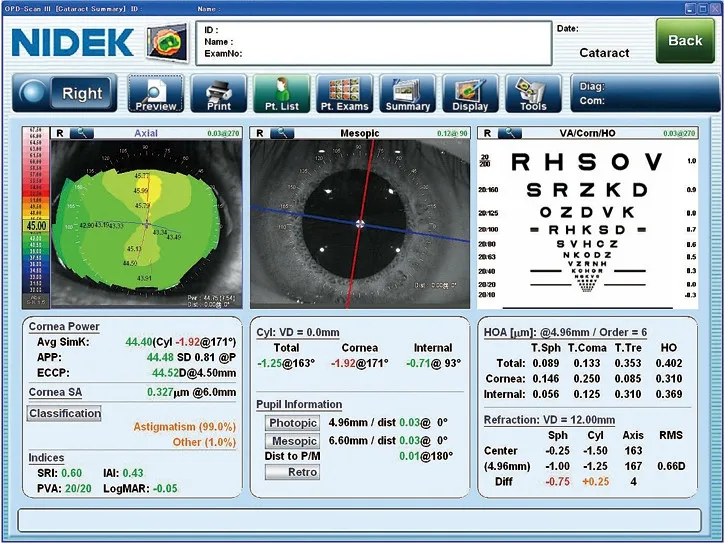
The autorefractometry is a quick examination that objectively measures your optical prescription (myopia, hyperopia, and astigmatism). It uses a device called an autorefractor : you look at a target while the device sends a gentle light, usually infrared, and analyzes how it is reflected back from the eye to estimate refraction. At Les Oliviers Eye Clinic in Sousse, Tunisia, autorefractometry provides a reliable starting point for the examination and is then refined, when necessary, by the clinical assessment.

Purpose Measure your prescription
Principle Automatic, painless measurement
Key point Result to be confirmed depending on the case
Why is autorefractometry performed?

Autorefractometry is very useful when a quick and accurate assessment is needed. It provides a numerical starting point, particularly during a vision check, when renewing glasses, for follow-up, or as part of a preoperative assessment. It can also help when the patient has difficulty describing their vision, for example because of fatigue, pain, young age, or limited cooperation, although a complete examination remains essential.

  • Vision assessment: Myopia, hyperopia, and astigmatism.
  • Starting point for the prescription: The result is then checked to determine the most comfortable correction.
  • Follow-up: Compare changes between two consultations.
  • Preoperative assessment: Depending on the indication and the care pathway.
Important: the autorefractor provides an objective measurement, but the “best correction” also depends on your visual comfort, near vision, and the quality of the ocular surface.

How is the examination performed?

You sit in front of the device with your chin on a support and your forehead against a bar. The examination generally takes only a few seconds for each eye. It does not require direct contact with the eye, making it reassuring, especially for sensitive patients.

  • Positioning: Stable position, looking at the target.
  • Automatic measurements: Several readings are taken to improve the reliability of the result.
  • Immediate result: Values displayed in diopters (sphere, cylinder, and axis).
  • Clinical verification: Depending on age, symptoms, and clinical context.
Is the examination painful?

No. Autorefractometry is painless. You may simply notice slight discomfort from the light or from maintaining fixation, but this lasts only a very short time.

Understanding the result

The report generally indicates: the sphere (myopia or hyperopia), the cylinder and the axis (astigmatism). This is a numerical snapshot of your refraction at a given moment. Depending on the situation, the doctor may adjust it to obtain the best vision and the greatest comfort.

  • Sphere: “+” for hyperopia and “–” for myopia.
  • Cylinder / Axis: Quantifies and indicates the orientation of astigmatism.
  • Interpretation: Fatigue, dryness, or accommodation can influence the measurement.
Autorefractometry in Sousse, Tunisia

Limitations to be aware of

In children and young adults, the eye accommodates easily. This may conceal part of the hyperopia or, conversely, produce a slightly different prescription depending on fatigue. Dry eye, irregular blinking, or poor fixation may also affect the measurement. This is why autorefractometry is an excellent starting point, but not always the final step.

  • Accommodation: Very common in younger patients.
  • Ocular surface: Dryness can reduce measurement stability.
  • Visual comfort: The “ideal” correction is the one that gives you clear vision and remains comfortable.
Tell us if your eyes sting, burn, or water. Improving the ocular surface can improve the reliability of the measurements.

Frequently asked questions

Do I need to fast?

No. Autorefractometry requires no special preparation. Simply bring your current glasses and, if possible, your previous prescriptions.

Does the autorefractor “replace” the doctor?

No. It takes measurements, but it does not interpret your discomfort, your near vision, or your medical context. The clinical examination remains essential for complete care.