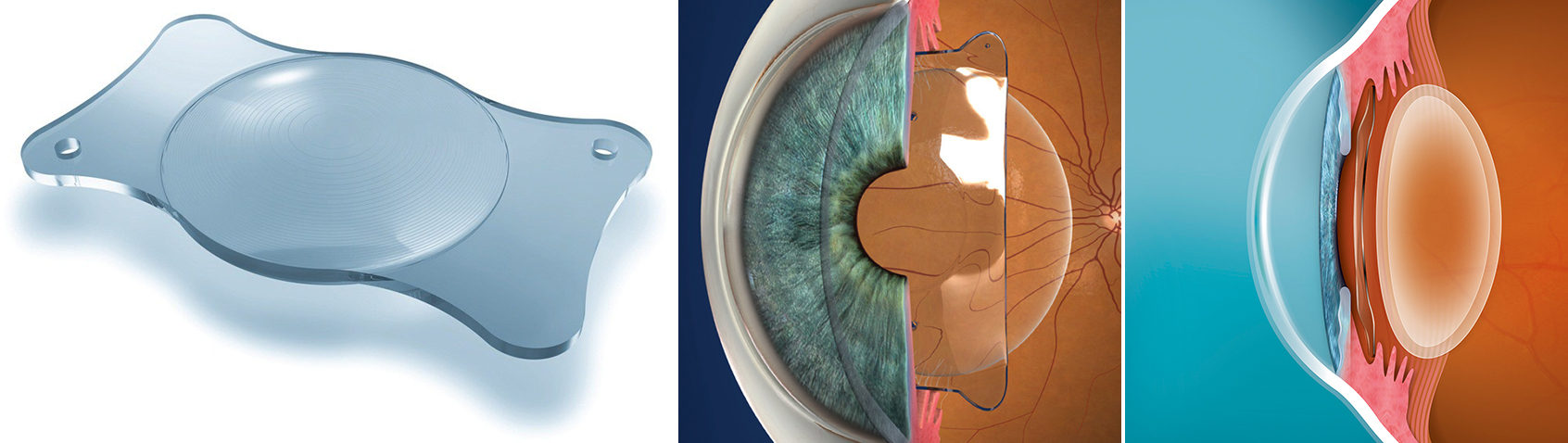
The ICL surgery , using an Implantable Collamer Lens, belongs to the family of phakic implants . It corrects myopia, and sometimes astigmatism, by adding a lens inside the eye without removing the natural crystalline lens. In other words, focusing is improved while preserving natural accommodation, especially in younger patients.
ICL surgery: phakic lenses
Who is ICL surgery suitable for?
ICL is often proposed when laser correction is not the most appropriate option, for example in high myopia, a thin cornea, significant dry eye, or when a solution that does not alter corneal shape is preferred. The key requirement is that the eye has sufficient internal space to accommodate the implant safely, which is measured during the preoperative assessment.
- Moderate to high myopia: When laser treatment is not ideal or not desired.
- Thin or fragile cornea: A solution that avoids removing corneal tissue.
- Dry eye: ICL may be more comfortable than certain laser procedures.
- Essential assessment: Anterior chamber depth, endothelial cell count, intraocular pressure, and other measurements.
How is the procedure performed?
The operation is designed to be short and precise. The surgeon makes a micro-incision and introduces the folded implant using an injector. Once inside the eye, the implant unfolds and is positioned behind the iris. The aim is stable alignment, good circulation of the fluid inside the eye, and rapid visual comfort.
Main steps
- Preparation: A complete assessment and personalized calculation of implant power and size.
- Local anesthesia: Most often with eye drops, together with careful monitoring.
- Micro-incision: A small opening through which the implant is inserted.
- Implantation: The lens is injected, unfolded, and positioned behind the iris.
- Final check: The surgeon checks centration, pressure, and proper fluid circulation.
What the patient experiences
- Perception of lights: You remain awake and are guided throughout the procedure.
- Mild discomfort: Often described as pressure rather than pain.
- Afterwards: vision may fluctuate during the first hours or days while the eye settles.
Why choose a phakic implant rather than laser treatment?
The advantage of ICL can be summarized simply: vision is corrected without reshaping the cornea. For certain patients, this may mean less dryness and very stable optical quality. Because the implant is an added lens, there is also a degree of “reversibility.” If a particular situation requires it, removal or exchange may be considered as a medical decision.
Quality of vision: what patients report
Many patients describe a more contrasted image and comfortable night vision, particularly when the original prescription was high. Perception remains individual and also depends on the health of the eye, including the retina and ocular surface.
Reversibility: what does this mean exactly?
The implant does not permanently alter the cornea. This does not mean that it is removed without a medical reason, but if the clinical situation changes, for example because of changes in the eye or a specific need, removal or exchange may remain possible.
What about near vision?
Because the natural crystalline lens is retained, the ability to focus at near distances is generally preserved in younger patients. Presbyopia develops naturally with age whether or not you have undergone surgery.
Postoperative recovery: what should you expect?
Recovery is generally straightforward, but it requires care and discipline. Eye drops reduce inflammation and protect the eye, while follow-up checks assess intraocular pressure and the correct position of the implant. For a few days, avoid rubbing the eye and exposure to dust, and follow the instructions regarding return to sport or swimming.
- The first few days: Watering, mild glare, and fluctuations in vision may occur.
- Eye drops are essential: follow the prescribed doses and duration strictly.
- Seek urgent medical attention if you experience: significant pain, sudden loss of vision, marked redness, very troublesome halos, or nausea.
Frequently asked questions
Can the implant be seen?
In most cases, no. The implant is placed behind the iris, so it is not visible like a contact lens. It can be examined with a slit lamp during follow-up.
Can astigmatism be treated?
Yes, depending on the model and indication. Toric versions are available to correct astigmatism as well. Precise centration and orientation are then especially important.
How long does the effect last?
The correction is designed to last as long as refraction remains stable. Like all human vision, it can change over time because of age, presbyopia, or retinal changes. Regular follow-up remains your best protection.
ICL or crystalline-lens surgery, such as cataract surgery?
ICL preserves the natural crystalline lens. Crystalline-lens surgery replaces it with an artificial implant. The choice depends on age, the presence of cataract, the prescription to be corrected, and the complete assessment.