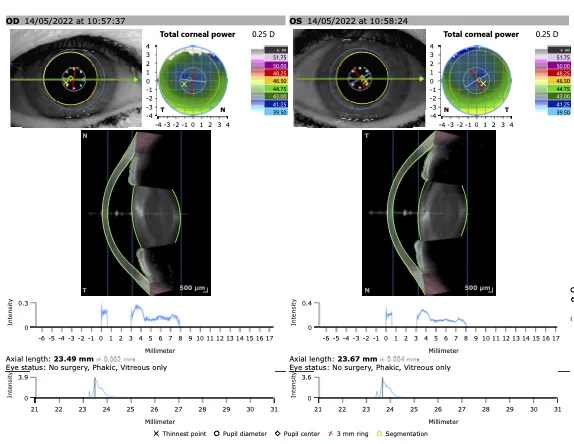
The biometry is the examination that measures the different segments of the eye with precision, including the length of the eye, corneal curvature, and anterior chamber depth. These data are mainly used to calculate the power of an intraocular lens before surgery, particularly cataract surgery and, depending on the indication, other implant procedures. At Les Oliviers Eye Clinic in Sousse, Tunisia, biometry is performed with great care because a difference of only a few microns can affect the quality of vision after surgery.
Biometry
What is ocular biometry used for?
Biometry can be compared to an “identity card” for the eye. It is essential for selecting the correct implant power. If the power is too low or too high, the patient may retain a residual prescription after surgery. It also helps anticipate anatomical features such as a long or short eye or a very steep cornea, improving the safety and personalization of the surgical procedure.
- Cataract surgery: Calculation of intraocular lens power.
- Choice of implant type: Standard, toric for astigmatism, and other options depending on the assessment.
- Surgical planning: Adapt the strategy to the anatomy of the eye.
- Special cases: Irregular corneas, previous surgery, and other particular situations.
How is the examination performed?
Modern biometry is most often optical: the device takes measurements without touching the eye. You place your chin on a support, look at a target, and the device performs several very rapid acquisitions. The measurements are then entered into formulas used to calculate the implant power.
- Positioning: Chin and forehead stabilized while looking at a target.
- Automatic measurements: Axial length, keratometry (curvature), and other parameters.
- Consistency check: Several acquisitions are taken to improve reliability.
- Medical interpretation: The implant and your visual objectives are selected with you.
Is it painful?
No. The examination is painless and very quick. The most important thing is to maintain fixation and remain still for a few seconds.
What exactly is measured?
Depending on the device and the assessment required, biometry may include several parameters. Together, these measurements are used to calculate the implant and tailor the visual plan, including distance vision, near vision, and correction of astigmatism.
- Axial length: A distance that has a major influence on implant power.
- Corneal curvature: Assesses the “power” of the cornea and astigmatism.
- Anterior chamber depth: Helps plan the operation and certain implant choices.
- Other parameters: Depending on the context, pupil diameter, thickness, and other measurements.
Practical advice before biometry
No extensive preparation is generally required. The important point is to bring information about your vision, including your glasses, previous prescriptions, and medical history. If you wear contact lenses, ask the team whether they should be stopped before the appointment, as this depends on the type of lens and the assessment planned.
- Bring your glasses: And, if possible, your previous prescriptions.
- Tell us about your contact lenses: Contact lens wear can alter corneal measurements.
- Tell us about your medical history: Previous surgery, trauma, corneal disease, and other relevant conditions.
Frequently asked questions
Is biometry alone sufficient to choose an implant?
It provides the essential measurements, but the final choice also depends on your lifestyle, your expectations for distance and near vision, the condition of the cornea and retina, and the complete clinical examination.
Should someone accompany me?
Biometry alone does not usually affect vision. If pupil dilation is planned on the same day as part of a broader assessment, you may be advised to come accompanied.