Back to top
+216 73 277 600
Examinations Surgery Technology Expertise
Pterygium Pterygium Eye surgery Book an appointment

Pterygium surgery

The pterygium is a small wing-shaped growth of conjunctiva, the transparent surface tissue, that extends onto the cornea, most often from the nasal side. At first, it mainly causes redness, a gritty sensation, and irritation in wind. As it progresses, it may distort the cornea , causing astigmatism and blurred vision. Surgery aims to remove the lesion cleanly and reconstruct a stable ocular surface in order to limit the risk of recurrence.

Important to know: The best everyday measures against recurrence are UV protection, management of dryness, and reduced exposure to irritation from dust and wind.
Purpose Remove the lesion and protect the cornea
Techniques Conjunctival graft / membrane according to the case
Key point Prevent recurrence + UV protection

When should a pterygium be operated on?

Surgery is not automatic. It is considered when the pterygium causes persistent daily discomfort, progresses, or begins to affect vision. In some situations, intervention is also preferred to protect the cornea or for functional reasons.

  • Persistent discomfort: Irritation, redness, or burning despite local treatment.
  • Progression: The pterygium advances and becomes more vascularized.
  • Visual effect: Induced astigmatism, fluctuating vision, or reduced sharpness.
  • Corneal involvement: Threat to the optical zone or surface scarring.
Pterygium in Sousse, Tunisia

How is the operation performed?

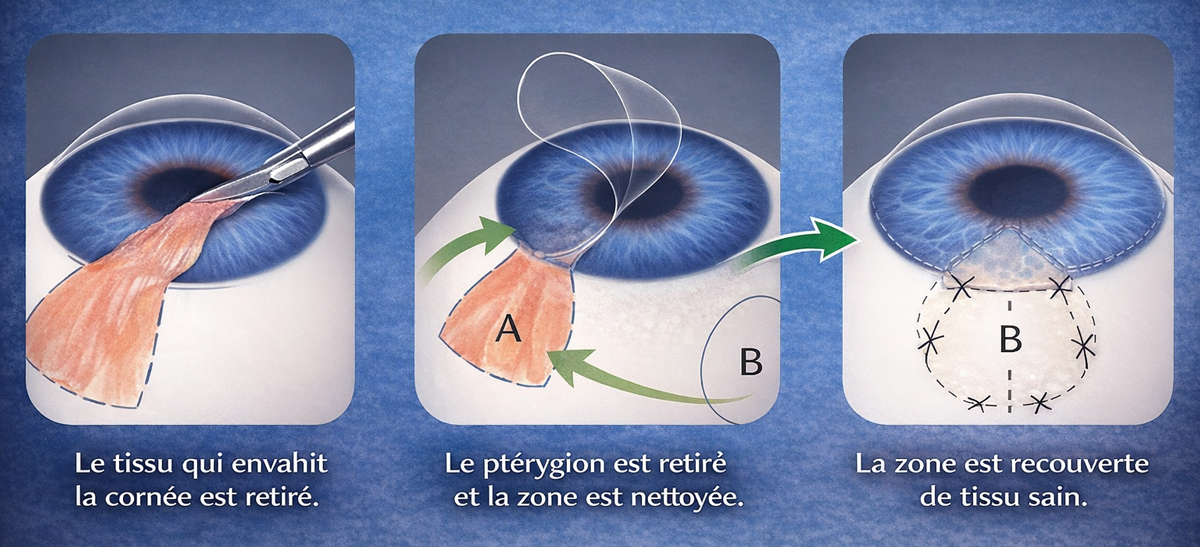
The operation is performed under local anesthesia using drops and/or contact anesthesia. The surgeon removes the lesion in a controlled manner and then reconstructs the conjunctival surface. This reconstruction is important because it improves comfort, healing, and, above all, prevention of recurrence.

  • Excision: Removal of the lesion and careful cleaning of the corneal area.
  • Reconstruction: Often a conjunctival autograft or another option according to the indication.
  • Fixation: Depending on the case, fine sutures and/or biological glue.
  • Final check: Assessment of stability and surface comfort.
Why is “recurrence” discussed so often?

Pterygium is associated with underlying factors such as UV exposure, dryness, wind, dust, and chronic irritation. Even after well-performed surgery, the tissue may sometimes grow again. This is why an appropriate reconstruction technique, careful postoperative treatment, and long-term UV protection are important.

Pterygium surgery in Sousse, Tunisia

Postoperative recovery: what is normal and what is not?

During the first few days, the eye may be red and sensitive, rather like after a scratch. This is often the time needed for the surface to re-epithelialize and inflammation to decrease. Prescribed eye drops reduce discomfort, protect the eye, and guide healing.

  • Discomfort and redness: Common at first, followed by gradual improvement.
  • Eye drops: Anti-inflammatory drops, with or without antibiotics, according to the protocol.
  • UV protection: Protective sunglasses, especially outdoors.
  • Seek prompt medical attention if you experience: significant pain, sudden loss of vision, thick discharge, or worsening redness.

Frequently asked questions

Will surgery leave a visible scar?

The area may remain slightly pink for a time and then gradually become clearer. The aim is the most natural appearance possible while prioritizing safety and prevention of recurrence.

Does vision always improve?

If the pterygium caused astigmatism or surface irregularity, improvement is common but may be gradual. The final correction also depends on the initial condition of the cornea.

Can I drive the next day?

This depends on your comfort, the eye operated on, and the instructions provided. Many patients arrange to be accompanied on the day of surgery and resume driving once vision is stable and comfortable.