Back to top
+216 73 277 600
Examinations Surgery Technology Expertise
Eye surgery Trabeculectomy Trabeculectomy Book an appointment

Trabeculectomy | Glaucoma surgery

The trabeculectomy is a reference surgical procedure used to lower intraocular pressure when glaucoma is not sufficiently controlled. Its principle is simple: create a new drainage pathway for the eye’s fluid in order to reduce pressure and protect the optic nerve over the long term.

Important to know: A successful trabeculectomy depends as much on healing as on the surgical procedure itself. This is why postoperative follow-up is essential: treatment is adjusted and, when necessary, certain parameters are modified to guide filtration.
Purpose Achieve a lower pressure
Principle Create filtration through a bleb
Key point Close postoperative follow-up
Why is trabeculectomy proposed?

Glaucoma progressively damages the optic nerve. Once these nerve fibers are lost, they generally do not regenerate. The main objective is therefore not to “improve” vision immediately but to stabilize the disease by reaching a target pressure suited to your eye.

  • Insufficient treatment effect: Eye drops and/or laser treatment do not achieve the target pressure.
  • Progression of glaucoma: Visual field testing or OCT shows deterioration despite good treatment adherence.
  • Need for a substantial pressure reduction: Some optic nerves require a particularly low pressure.
  • Personalized decision: Age, type of glaucoma, eye anatomy, and medical history all play an important role.

The principle: create a controlled drainage pathway

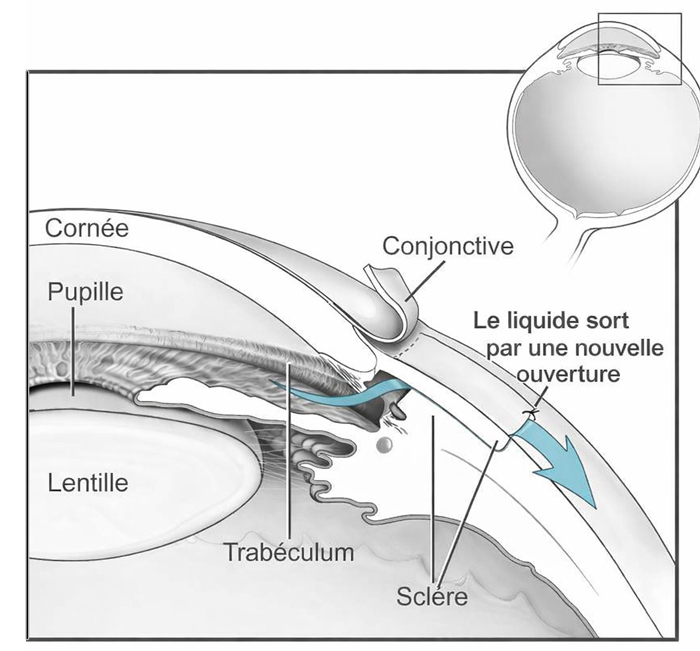
The eye continuously produces a clear fluid called aqueous humor. When drainage is impaired, pressure rises. Trabeculectomy creates a drainage pathway beneath a small flap in the sclera, the white part of the eye, allowing fluid to flow into a filtration area beneath the conjunctiva. This is the filtering bleb. It acts as a discreet reservoir designed to reduce pressure over the long term.

How is the procedure performed?

In practice, the operation is performed in the operating room under appropriate anesthesia, often local anesthesia. The surgeon creates a small flap, establishes the filtration opening, and closes the tissues with fine sutures. The aim is to find the correct balance: enough filtration to lower pressure, but not so much that the eye becomes unstable or uncomfortable.

Trabeculectomy for glaucoma in Sousse, Tunisia

Steps of the procedure

  • Anesthesia and preparation: The eye is numbed and a sterile surgical field is prepared.
  • Creation of the flap A small “lid” is created in the sclera to control fluid flow.
  • Filtration opening: The new drainage pathway for the aqueous humor is created.
  • Fine sutures: These regulate filtration and allow careful closure.

After the operation

  • Postoperative eye drops: Anti-inflammatory drops are essential, and antibiotics are sometimes prescribed.
  • Close follow-up: Pressure, the appearance of the bleb, and healing are monitored.
  • Warning signs: Significant pain, sudden loss of vision, or marked redness require immediate medical attention.

Frequently asked questions

Does trabeculectomy “cure” glaucoma?

It does not cure the disease, but it aims to control it by lowering pressure. Glaucoma remains a chronic condition, and long-term follow-up is always necessary.

Will I be able to stop all my eye drops?

Sometimes yes and sometimes no. Many patients reduce the number of drops they use, but the main objective remains a safe pressure. Treatment is decided according to the result and ongoing follow-up.

Is the filtering bleb visible?

It is generally discreet and located beneath the upper eyelid. It is mainly visible during the clinical examination, and its appearance is part of routine follow-up.