Back to top
+216 73 277 600
Examinations Surgery Technology Expertise
Eye surgery Corneal transplant Corneal transplant Book an appointment

Corneal transplant

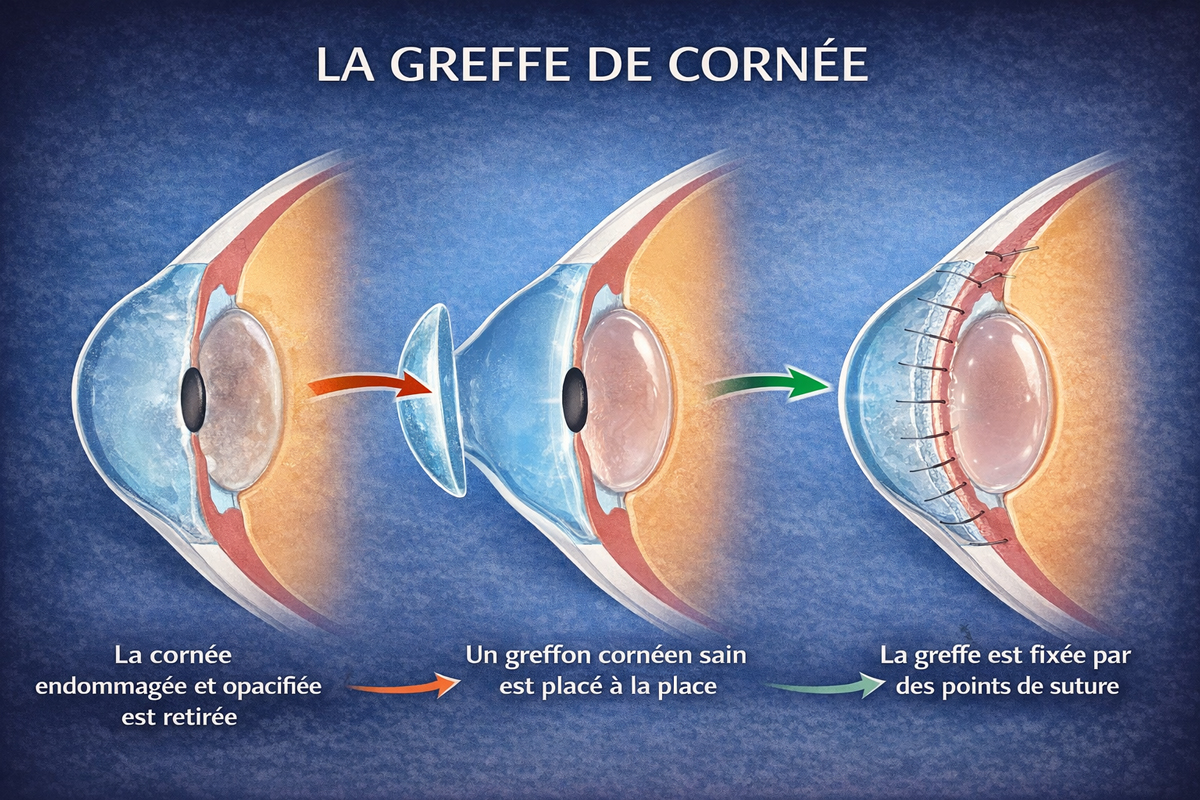
The corneal transplantation , or keratoplasty, is surgery that replaces a cornea that has become cloudy, distorted, or fragile with healthy tissue in order to restore a clearer and more regular corneal surface. Depending on the problem, the surgeon may replace the entire cornea or only the affected layer . This tailored choice can make a major difference to visual recovery.

Important to know:A corneal transplant is not a “comfort procedure.” It is optical-reconstructive and sometimes protective surgery that requires genuine cooperation between patient and doctor throughout follow-up.

Purpose Restore transparency and optical quality
Techniques Full-thickness or targeted lamellar transplant
Key point Careful follow-up + long-term eye drops
When is a corneal transplant considered?

A transplant is proposed when the cornea no longer performs its role as the eye’s clear “window” and usual solutions such as medical treatment, contact lenses, or glasses are no longer sufficient. The right time is not determined by a number on a report, but by the real effect on your vision, comfort, and the safety of the eye.

  • Corneal opacity: Scarring after infection, trauma, or burns.
  • Progressive distortion: For example, advanced keratoconus or a very irregular cornea.
  • Corneal edema: Failure of the inner endothelial layer.
  • Fragility / risk: Some corneas become too thin or unstable.
A transplant is not automatically “full-thickness.” Whenever possible, a more targeted transplant is preferred, replacing only the diseased layer. This can accelerate recovery and reduce certain risks.

Full-thickness or partial transplant: how is the decision made?

Today, the technique is selected according to the layer mainly affected. The objective is to replace only the diseased tissue whenever possible. If the full corneal thickness is involved, a penetrating, or full-thickness, transplant may be selected. If the problem mainly affects the front, such as superficial scarring, or the back, such as the endothelium, a lamellar transplant may be preferred.

Penetrating keratoplasty (PK): complete replacement

The central cornea is replaced through its full thickness. This is a reliable technique, but recovery may be longer and sutures play an important role.

Lamellar transplants: targeted replacement

Only selected layers are replaced. When indicated, this may accelerate recovery and reduce certain risks. The choice is made after a detailed examination including topography, pachymetry, microscopy, and other investigations.

How is the operation performed?

The operation is performed in the operating room under suitable anesthesia, often local and sometimes general depending on the circumstances. The surgeon removes the diseased tissue, positions the graft, and stabilizes it, usually with very fine sutures. The aim is to obtain a well-centered, stable, and regular cornea.

  • Preparation and anesthesia: Comfort and immobility of the eye during the procedure.
  • Replacement of affected tissue: Full or partial according to the technique.
  • Graft stabilization: Fine sutures and a final check.
  • Follow-up plan: Essential check-ups and eye drops.
Corneal transplant in Sousse, Tunisia

Postoperative recovery: what you need to know

Recovery is gradual. The cornea heals, sutures stabilize, and vision refines over time. Anti-inflammatory eye drops, often required over the long term, help protect the graft. Follow-up is used to detect abnormal inflammation, elevated intraocular pressure, or signs of rejection at an early stage.

  • The first few weeks: Vision may fluctuate and light sensitivity may occur.
  • Eye drops: Use them exactly as prescribed because they protect the graft.
  • Seek prompt medical attention if you experience: pain, marked redness, sudden loss of vision, or photophobia.