Back to top
+216 73 277 600
Examinations Surgery Technology Expertise
Eye surgery Cataract cataract Book an appointment

Laser refractive surgery

Laser refractive surgery aims to correct certain visual defects such as myopia, astigmatism, and, in some cases, hyperopia, in order to reduce dependence on glasses or contact lenses. The principle is to reshape the cornea very precisely to improve the focusing of the image on the retina. At the Les Oliviers Ophthalmology Clinic in Sousse, the choice of technique is made after a complete preoperative assessment: corneal thickness, topography, dry eye, stability of the correction, and the patient's expectations.

Objective To correct certain visual defects
Techniques Conventional LASIK, FemtoLASIK, PRK
Key Point Corneal assessment is essential
Who is refractive surgery for?

Refractive surgery is not a decision based solely on the degree of myopia or astigmatism. Two patients with the same prescription may receive two different recommendations, because the cornea, dry eye, age, occupation, night driving habits, and visual stability are all significant factors. The goal is to achieve an effective correction, but above all, a safe and lasting one.

  • Stable correction: Vision should not change significantly from year to year.
  • Suitable cornea: Thickness, regularity, and topography must be compatible.
  • Comfortable eye: Dry eye should be assessed and treated if necessary.
  • Realistic expectations: The goal is a more comfortable life, not the same promise for everyone.
The pre-operative assessment is the crucial safety step: it determines which technique is appropriate, or sometimes even recommends against surgery.

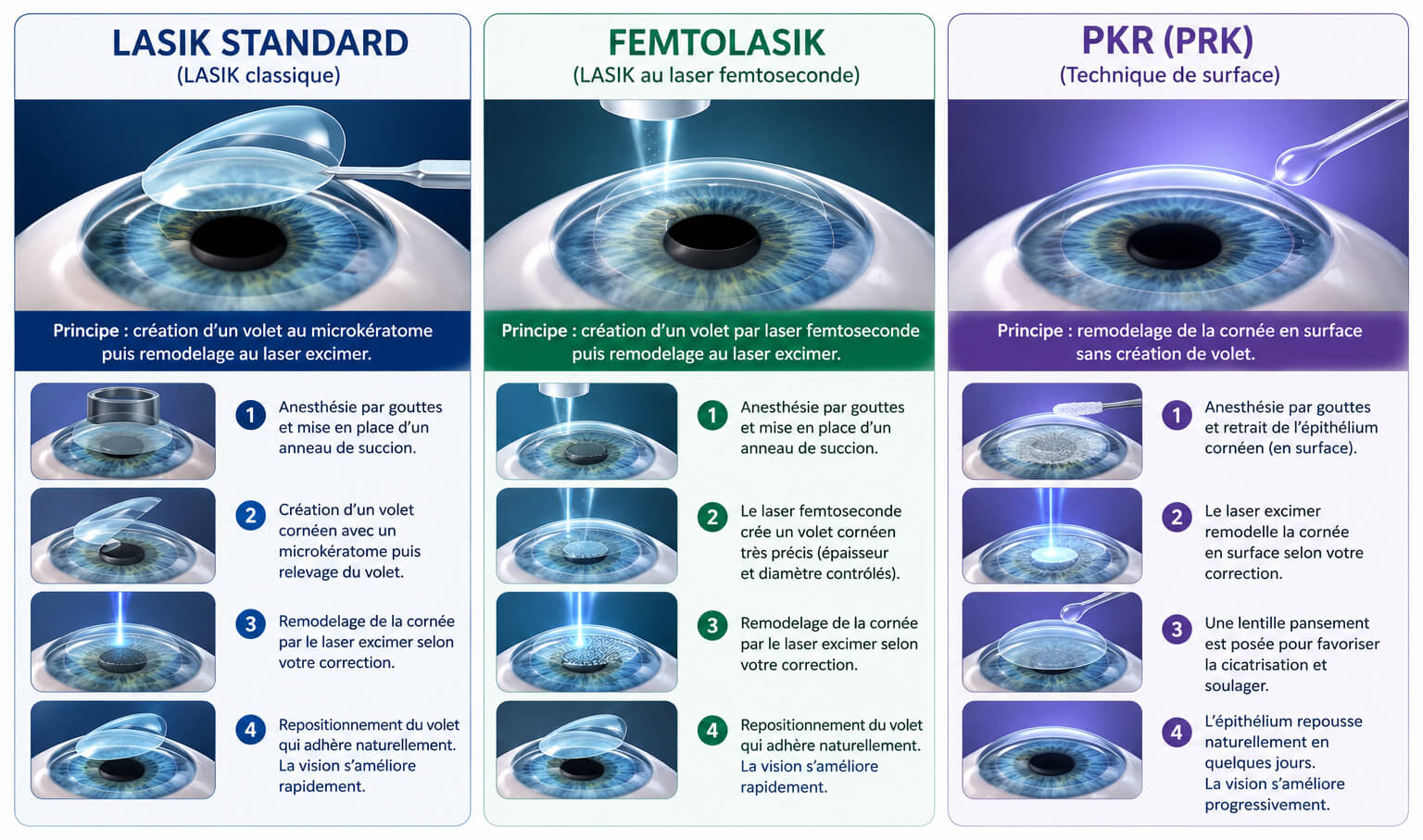
The 3 techniques offered: conventional LASIK, FemtoLASIK, and PRK

All three techniques use a laser to reshape the cornea, but access to the treatment area differs. The choice depends primarily on corneal anatomy, desired comfort, potential recovery time, and the patient's visual profile.

Laser refractive surgery in Sousse, Tunisia

1) Conventional LASIK

Conventional LASIK involves creating a thin corneal flap, then using an excimer laser to reshape the cornea from within. The flap is then repositioned naturally. This technique is known for often resulting in rapid visual recovery when the eye is properly selected.

  • Principle: Corneal flap + excimer laser.
  • Advantage: Generally fast recovery.
  • Condition: Sufficiently thick and regular cornea.

2) FemtoLASIK

FemtoLASIK uses the same principle as LASIK, but the corneal flap is created with a femtosecond laser instead of a mechanical instrument. This allows for a very precise and customized flap creation, before reshaping with the excimer laser.

  • Principle: Femtosecond laser flap + excimer correction.
  • Advantage: High precision in flap creation.
  • Condition: Favorable corneal assessment and well-defined indication.

3) PRK: The Surface Technique

PRK (or PRK) does not create a corneal flap. The laser acts on the surface after removal of the corneal epithelium, which then regenerates naturally. Recovery is more gradual than with LASIK, with a few days of possible discomfort, but this technique may be preferable for certain thinner corneas or specific profiles where a flap is to be avoided.

  • Principle: Surface laser treatment, without a flap.
  • Advantage: An interesting option for certain thin corneas or specific profiles.
  • To expect: Slower recovery, bandage contact lenses, and postoperative eye drops.

The preoperative assessment: the most important step

Before discussing the technique, it is essential to verify that the eye is a suitable candidate for surgery. The assessment examines the cornea, visual quality, dryness, intraocular pressure, and the fundus if necessary. This step allows for a choice between conventional LASIK, FemtoLASIK, or PRK, as well as defining the limitations and realistic goals of the procedure.

  • Corneal topography: Mapping of the shape and regularity of the cornea.
  • Pachymetry: Measurement of corneal thickness.
  • Refraction: Precise measurement of the correction to be treated.
  • Dry eye: To be screened for before the procedure to improve comfort afterward.
Successful refractive surgery begins before the operating room: choosing the right indication is more important than the "commercial" choice of a technique.

Procedure Procedure

The procedure is performed on an outpatient basis, under anesthesia with eye drops. The patient is positioned under the laser, the eye is held open with a small speculum, and the treatment is generally very short. The laser is programmed based on the measurements taken during the initial assessment. During the procedure, it is essential to focus on a light and follow the team's instructions.

  • Anesthesia by eye drops: No general anesthesia in most cases.
  • Personalized laser treatment: Based on your prescription and cornea.
  • Quick recovery: Discharged the same day, with instructions and treatment.
  • Check-ups: Essential to monitor healing and vision.
Is it painful?

During the procedure, the anesthesia by eye drops generally makes the procedure painless. After LASIK/FemtoLASIK, discomfort is often mild and short-lived. After PRK, discomfort may be more pronounced for a few days, while the corneal surface heals.

After the Procedure: Recovery and Precautions

The recovery period varies depending on the technique. After LASIK and FemtoLASIK, visual recovery is often rapid. After PRK, vision improves more gradually. In all cases, it is essential to use the eye drops, avoid rubbing your eyes, protect the surface of your eyes, and attend all scheduled follow-up appointments.

  • Eye drops: Antibiotics, anti-inflammatories, and lubricants as prescribed.
  • No rubbing: Especially during the first few days.
  • Protection: Sunglasses, avoid dust, swimming pools, and makeup as instructed.
  • Consult a doctor promptly if…: significant pain, sudden decrease in vision, intense redness, or discharge.

Frequently Asked Questions

Which technique is best: LASIK, FemtoLASIK, or PRK?

There is no single best technique for everyone. FemtoLASIK can be very comfortable for some patients, PRK may be better suited to certain corneas, and conventional LASIK remains an option depending on the equipment and the indication. The assessment determines the best course of action.

Does refractive surgery always eliminate the need for glasses?

The goal is to significantly reduce dependence on glasses or contact lenses. Some patients may still require correction in specific situations, particularly depending on age, presbyopia, or visual requirements.

Can both eyes be operated on the same day?

This depends on the protocol, the technique, and the assessment. The decision is made with the surgeon, after an explanation of the benefits and precautions.