Back to top
+216 73 277 600
Examinations Surgery Technology Expertise
Eye surgery Cataract cataract Book an appointment

Cataract surgery

A cataract is a progressive clouding of the crystalline lens. Light passes through the eye less effectively, contrast fades, and vision becomes as though it were “veiled.” cataract surgery consists of removing the clouded crystalline lens and replacing it with an implant, or artificial lens, suited to your eye and lifestyle.

Purpose Restore clear and comfortable vision
Common procedure Phacoemulsification + intraocular lens
After the procedure Follow-up + eye drops, with a gradual return to activities
When should cataract surgery be considered?

A cataract is not operated on simply because it exists, but because it causes genuine difficulty: problems driving at night, glare, tiring reading, dull colors, or frequent changes in glasses. The right time is when the cataract prevents you from living normally even with the best optical correction.

  • Blurred or misty vision: A veil-like sensation, less-fine detail, and reduced contrast.
  • Glare: Headlights at night, sunlight, and reflections may cause light to “spread.”
  • Visual fatigue: Reading and screen use become more demanding and require more breaks.
  • Rapid changes in prescription: Glasses that never seem to remain suitable for long.

How is cataract surgery performed?

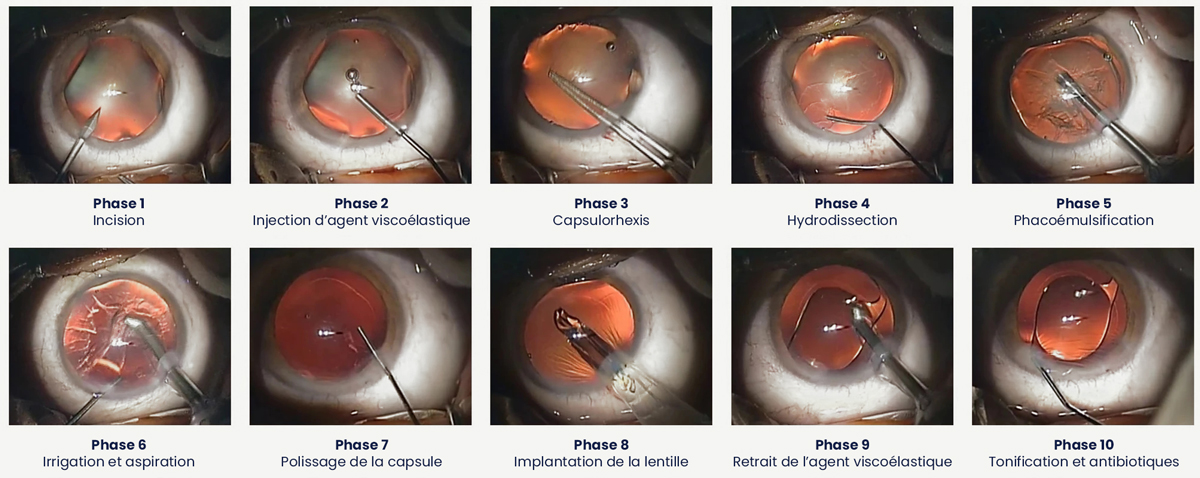
The principle is precise and straightforward: the surgeon reaches the crystalline lens through a micro-incision, fragments and removes the cataract, and then places a clear implant in its position. The eye itself is not “replaced.” The clouded crystalline lens is replaced by a transparent lens designed to remain securely in place over the long term.

Practical steps

  • Local anesthesia: Usually with eye drops, supplemented if necessary. The procedure is generally painless.
  • Micro-incision: A very small opening provides access to the crystalline lens.
  • Phacoemulsification: The cataract is fragmented and gently removed by aspiration.
  • Intraocular lens: The implant unfolds inside the eye and replaces the crystalline lens.
  • Final check: The surgeon checks stability, watertightness, and protection of the eye.

What the patient experiences

  • You remain awake: You may perceive lights, colors, and movement.
  • Little or no pain: The sensation is more often one of pressure or manipulation.
  • Afterwards, the eye may feel sensitive: Stinging, watering, or mild discomfort may occur at first.
Tip: good preparation, including eye drops, eyelid hygiene, and following instructions, simplifies recovery and improves postoperative comfort.
Cataract surgery in Sousse, Tunisia

Which implant should be chosen?

Every patient receives an implant, but not necessarily the same type. The choice depends on the shape and measurements of your eye, your activities such as reading, computer work, and driving, and your visual expectations. An implant that looks “ideal” on paper is not always the best choice for daily life. The decision is personalized and made with your surgeon.

Monofocal implant, mainly for distance vision

This is the most conventional option: clear vision at one distance, usually far away. Glasses may still be required for reading. Its main advantage is excellent image quality with few light-related visual phenomena.

Toric implants, to correct astigmatism

If you have significant astigmatism, a toric implant can reduce dependence on glasses for distance vision. It must be positioned very precisely.

Multifocal / EDOF implants, for several distances

These implants aim to provide greater independence across several distances, including far and intermediate vision and sometimes near vision. In return, some people report night halos or sensitivity to light. The patient’s individual profile is extremely important.

Postoperative recovery: what should you expect?

Vision may become clearer quickly, but the eye continues to stabilize. Eye drops, including anti-inflammatory and sometimes antibiotic drops, are essential. Patients are also advised to avoid rubbing the eye, dust, and certain physical efforts for a few days, according to medical instructions.

  • The first few days: Vision may fluctuate, light sensitivity may occur, and the eye may feel gritty.
  • Follow-up: Scheduled check-ups assess healing and intraocular pressure.
  • Seek urgent medical attention if you experience: significant pain, sudden loss of vision, marked redness, flashes, or a dark curtain or shadow.

Frequently asked questions

Can the cataract “come back”?

The cataract itself cannot return because the clouded crystalline lens has been removed. However, the membrane supporting the implant may become cloudy over time, a condition known as posterior capsule opacification. This can usually be treated quickly with a laser during an outpatient visit.

Will I be able to stop wearing glasses?

Sometimes completely, but often only partially. Many patients gain comfort and use their glasses less, but the result depends on the implant selected, any astigmatism, and your need for near vision.

How long does recovery take?

A return to everyday activities is often rapid, but full visual stabilization may take longer. Your doctor will provide a clear schedule for eye drops, follow-up, and activities to avoid.