The strabismus is a misalignment of the eyes . One eye may turn inward, outward, upward, or downward. In children, the main issue is often binocular vision , meaning learning to use both eyes together. In adults, strabismus may cause visual fatigue, cosmetic concern, and sometimes double vision. Surgery acts on the eye muscles to rebalance their forces and realign the eyes.
Strabismus surgery
Why operate on strabismus?
Surgery is not performed “only for appearance,” although the social and psychological impact is important. The objective is to obtain more stable alignment, reduce visual fatigue, and, in some patients, improve cooperation between the two eyes. The decision is based on the type of strabismus, its progression, and the expected benefit.
- Stable, troublesome strabismus: A visible deviation or significant discomfort.
- Double vision in adults: Diplopia in certain positions of gaze.
- Preserve binocular vision in children: Help both eyes work together.
- Secondary strabismus: After trauma, thyroid disease, paralysis, and other causes.
The principle of surgery
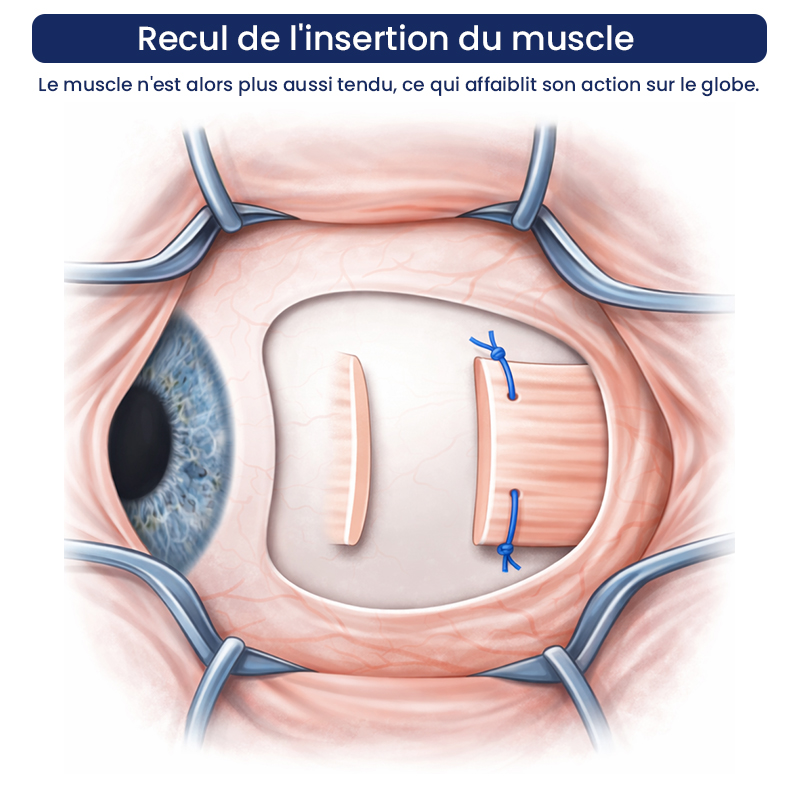
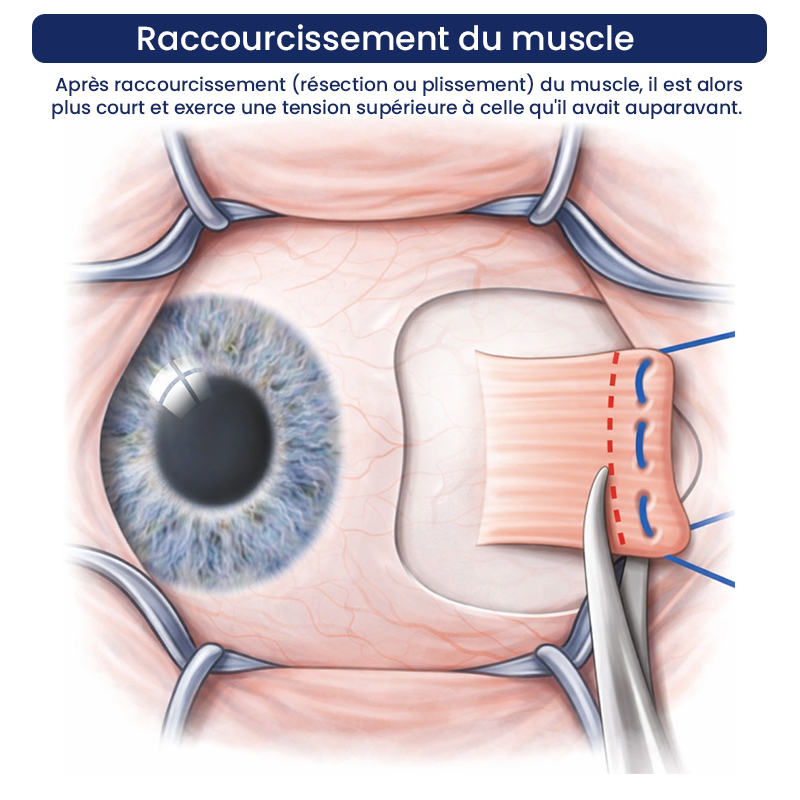
Strabismus surgery does not enter the inside of the eye. It acts on the muscles that move the eye. Depending on the deviation, the surgeon may weaken an overactive muscle by moving it backward or strengthen an underactive muscle by shortening or advancing it. The aim is a balance tailored to the type of strabismus.
- Recession: Move a muscle backward to reduce its strength.
- Resection / plication: Shorten or reinforce a muscle to increase its strength.
- Personalized strategy: The number of muscles operated on depends on the deviation and overall balance.
Are both eyes always operated on?
Not necessarily. Depending on the deviation and symmetry, surgery may involve one eye or both. The aim is to achieve the most natural and stable alignment possible.
How is the procedure performed?
The operation is performed in the operating room, most often under general anesthesia in children. In adults, general anesthesia or enhanced local anesthesia may be proposed depending on the case. The surgeon reaches the muscles through a small incision in the conjunctiva, the “white of the eye,” and then adjusts the position of the relevant muscle or muscles.
- Suitable anesthesia: Comfort and safety according to age and circumstances.
- Access to the muscles: A conjunctival incision without opening the inside of the eye.
- Muscle adjustment: Precise adjustment of tension and position.
- Assessment and follow-up: Check alignment and healing.
Postoperative recovery: what is usual
After surgery, the eye may be red, sensitive, and watery for a few days. A gritty sensation is common. Alignment often improves quickly and then stabilizes over several weeks. In some cases, orthoptic rehabilitation or adjustment of optical correction may be useful.
- Redness and watering: Common at first, then gradually decrease.
- Eye drops: Anti-inflammatory drops, with or without antibiotics, according to the protocol.
- Stabilization: Alignment settles over several weeks.
- Seek medical advice again if you experience: significant pain, loss of vision, thick discharge, or fever.
Frequently asked questions
Does surgery guarantee “perfect” alignment?
Surgery aims for the best possible alignment, but stability depends on the type of strabismus, visual history, and muscle response. An additional adjustment or procedure may sometimes be discussed.
Does surgery improve vision?
It mainly improves alignment and comfort. In children, it may support the development of binocular vision, but amblyopia also requires other treatments.
When can school or work be resumed?
Often quite quickly, depending on comfort. Redness may persist for several days or weeks and is generally not serious.